
LISTEN TO THE EPISODE HERE:
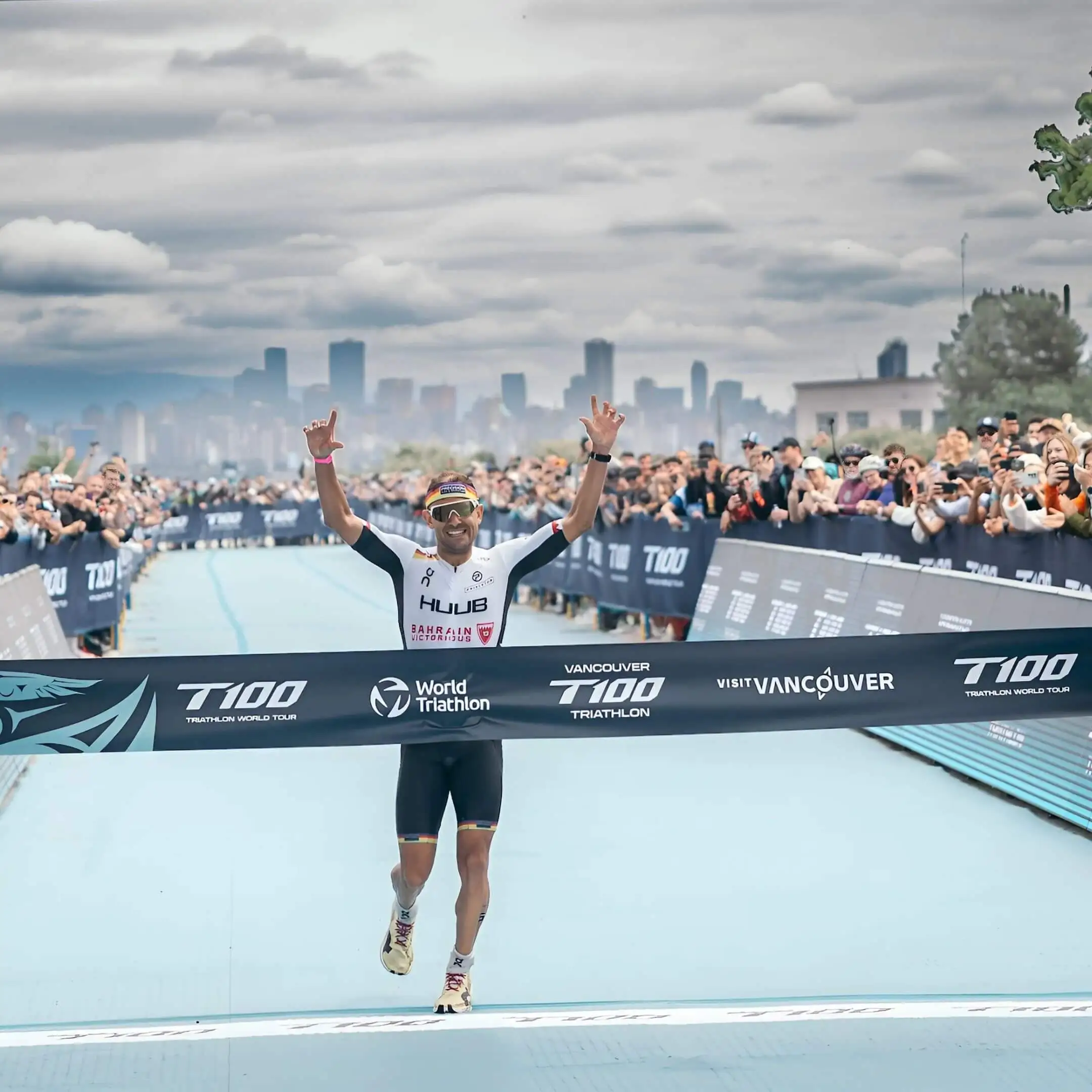
Jelle Geens is the reigning Ironman 70.3 World Champion, a three-time Olympian, and has multiple big wins across the World Triathlon Championship Series, T100 World Tour and Ironman 70.3 on his resume. We discuss Jelle's training in great detail in this episode, and we also cover other bits and pieces like his new training environment on the Gold Coast, how his training and life have changed since having a daughter, and tourism tips for Belgium.
HIGHLIGHTS AND KEY TOPICS:
- How Jelle got into triathlon, his short-course racing career, and his three Olympic experiences
- Transitioning from short-course to middle-distance racing, getting used to the TT-bike, and Jelle's first (unsuccessful) DIY bike fit
- Comparing the squad training environment in Girona with in-person coaching to more independent training with remote coaching (under Ben Reszel) on the Gold Coast
- Jelle's training structure overall, and specifics across swim, bike and run (including typical key sessions)
- A breakdown of a full training week in preparation for T100 London
- How Jelle tapers into races, and recovers after them
- Jelle's Ironman and Kona plans
Sponsored by:

Precision Fuel & Hydration
Precision Fuel & Hydration produce our favourite gels, sports drinks, and electrolyte and carbohydrate products here at That Triathlon Show and Scientific Triathlon. Use the free Fuel & Hydration Planner to get a personalised plan for your carbohydrate, sodium and fluid intake in your next event, and get 15% off your first 2026 order by using the code TTS2026 at checkout.
Shownotes
Personal life
03:05 -
- I suppose most people who follow triathlon already know this, but I have a daughter now. She is twenty months old, and her arrival has changed my life drastically. It was a period of many transitions, as I also shifted from Olympic distance to long distance racing, changed coaches, moved to another country, and then welcomed a daughter.
- All of these changes were significant, and while becoming a parent is not directly sport-related, it does affect my sporting life. It certainly makes things busier and, at times, more complicated as a professional athlete. Still, I believe the benefits far outweigh the challenges of planning and structuring daily life.
- The best part of having a daughter is watching her grow up. It is incredibly rewarding to see her reach new stages of development. She is now beginning to understand more and can already explain some of what she wants or feels, even if her vocabulary is still limited.
- Looking back at photos from a year ago, the progress is remarkable. She took her very first steps in Taupo, and in just seven or eight months she has gone from crawling to running around fearlessly.
- At home, we manage her language exposure carefully. When the three of us are together, we speak English so that my partner Kate understands everything. When I am alone with her, or when we are with my family in Belgium, we speak Dutch.
- Before this trip to Europe, most of the words she understood and spoke were in English. However, after just two weeks here, I can already see that she is picking up more Dutch words. She usually calls me “daddy,” but every now and then she surprises me by saying “papa,” which is Dutch, and I find that really special.
Jelle’s start in triathlon
05:25 -
- I first became interested in triathlon in the summer of 2008. Until then, I had focused on athletics, but I was beginning to feel somewhat tired of running as my only sport. While on our usual summer holiday in Spain, I told my parents that I wanted to try triathlon.
- My father had done the sport himself, so I knew what it was, but there was a problem: I could not swim. That summer I started swimming a little in the pool, and I decided to finish the athletics season before joining a triathlon club in the winter to learn to swim once or twice a week.
- My first real triathlon season came in 2009, when I was sixteen years old. I combined both athletics and triathlon, racing in about three or four triathlons and around ten running races that year. Swimming was my biggest challenge, as I only started at fifteen or sixteen.
- Learning technique at that age was not easy, and it became a long journey to catch up with others who had been swimming since childhood. It has always been my weak point, my Achilles heel in triathlon. Still, I feel that swimming fits me better now in long-distance or middle-distance racing.
- The emphasis on pure speed, such as in fast 100s, is less critical at longer distances. It is also less decisive in races: even if you come out of the water in the second pack, you often have a real chance to recover. In short-course racing, however, drafting makes it almost impossible to come back if you are not in the main peloton, and I had races where it was essentially over as soon as I left the water.
- My first international experiences came in 2011, when I was in my second year as a junior. I did not actually meet the qualification criteria, but I was given the opportunity to compete at the Junior European Championships.
- Out of the blue, I finished second, just behind an athlete I still race against today in the T100 series. That result was a turning point. Around the same time, I was starting university and decided to slow down my studies in order to pursue triathlon seriously, taking my degree at half the normal pace. It ended up taking me even longer, but I did finish in the end. What mattered most was that I had discovered some real talent and wanted to see how far I could take it.
- My breakthrough at the senior level came in 2015 at the World Triathlon Series Grand Final in Chicago, when I was twenty-two years old. I finished eighth, which at the time was the best-ever Belgian result in a WTS race or at least in a Grand Final.
- The progression felt natural: in 2014 I had already stood on a European Cup podium, even though in my very first WTS race that same year I nearly got lapped. By 2015, to reach the top eight in the Grand Final made me realize that I was moving in the right direction.
Short course distance career highlights
10:52 -
- I would say that I really came onto the scene and began fighting for medals in 2019. After qualifying for the Rio Olympics but missing the swim pack—and essentially having my race end right there—I decided to change coaches and joined Joel’s training group.
- The first two years were difficult as my body adjusted to the new workload. I suffered a stress fracture early on because the jump in training volume was significant compared to what I had done before.
- By the winter leading into 2019, things started to come together. I could follow athletes like Mario Mola and Vincent Luis in training, and I felt that I was finally capable of competing at the top level.
- That year, after some inconsistent results, everything clicked in Montreal, where I won my first WTCS race. It was historic, as I became the first Belgian ever to win a WTCS race or even stand on the podium. I finished ahead of Mario Mola, and a week later I placed thirteenth in Hamburg. Those two performances were really the moment I made my name internationally in short-course triathlon.
- In the years that followed, I was consistently in the mix for medals. I finished on the podium six times in WTCS races, with two wins—Montreal in 2019 and Abu Dhabi in 2021. Like everyone racing short course, my big goal was the Olympics.
- The Tokyo Games were postponed from 2020 to 2021, and in that season I finished second in Yokohama, just behind Kristian Blummenfelt, who went on to win Olympic gold. Unfortunately, just before flying to Tokyo I tested positive for COVID-19, despite being vaccinated. For ten days I tested daily, hoping to make it to the start line of the individual race, but I was not cleared in time. I did eventually travel to Tokyo and raced in the mixed team relay, where we finished fifth.
- In 2022 I had my best season overall. Despite an early injury, I was consistently close to the podium, finishing fourth or fifth several times, and I ended the year third at the Grand Final and fourth in the overall WTCS ranking—the best of my career. The main challenge for me in short course was consistency. While I could reach very high performances, maintaining them week after week was more difficult.
- From 2023 onwards I began to struggle, both mentally and physically. Training still went well, but in races I could not reproduce the same level I had shown before. I still managed to reach the podium in Montreal, but overall the season was disappointing.
- I remained focused on Paris, determined to get redemption for missing the individual race in Tokyo. Looking back, perhaps I should not have extended my time in short course, because Paris was another heartbreak. I fell ill just days before the race and had a terrible experience. The whole Olympic journey there became one of the lowest points of my short-course career.
- If I had to choose a single highlight from that period, two moments stand out. The first is winning my debut WTCS race in Montreal in 2019, which was completely unexpected and a shock to many, since my best result until then had only been sixth.
- The second is my victory in Abu Dhabi at the end of 2021. That result was especially emotional, coming after the disappointment of missing the individual Olympic race in Tokyo, breaking my scaphoid in Montreal shortly afterwards, and then working my way back to form. To finish that year with a win gave me a strong sense of pride and resilience.
Missing short-course racing
16:59 -
- At the moment, I honestly do not miss short-course racing. What I do miss are the friendships I built within my training group and the experience of training together. That part was special, and I value it. But with how life is now—having a twenty-month-old daughter—it is actually easier from a planning perspective to train alone most of the time.
- Mentally, I had reached a point where I was over short course, so switching to middle distance, racing 70.3 and T100 events, felt like both a relief and a refreshing change.
- The results came quickly and went better than I expected, which only reinforced that it was the right decision. I do not look back with regret or wish I were still racing short course. I will happily watch the WTS races the day after competing myself, but I will not find myself thinking, “I wish I were there racing.”
Moving from Girona to Australia
18:22 -
- The move itself was exhausting. We had to pack up our house while I was in the middle of training for Taupo, and we relocated about five weeks before the race. Travelling with all our belongings to Australia and then settling in was stressful.
- We stayed with Kate’s parents until after Taupo, which was the right decision because having their support helped while I was still training at a high level. The start of this year was also challenging as we moved into our own place. Buying furniture, assembling everything, and setting up the home took a lot of time and energy.
- Now, however, we are fully settled, and it feels like home. We are really happy in Australia. It is a wonderful country, and I think it is an ideal place for a child to grow up, with so many outdoor activities available.
- My training environment has also changed significantly. Before, I trained almost exclusively in a group, with very few solo sessions and my coach always present. Now, I do most of my training alone. I still occasionally join others for some swims, bike rides, or runs, but most of the time I train independently, guided by online coaching.
- I am in daily contact with my coach, but the dynamic is different from having him physically there. This shift was something I was ready for, and it makes sense at this stage of my life. With a young daughter, it is easier to plan training around family life when I am not bound to the fixed schedule of a group. I have more flexibility, which allows Kate to do what she needs and gives me time to spend with my daughter—something I truly value.
- This independence has also changed my mindset towards training. In the past, triathlon was everything to me, and I invested not only time and effort but also a lot of mental energy into it. Now it feels more like a job—one that I enjoy deeply, but still a job.
- I focus on executing what my coach prescribes, hitting the targets for pace or power, and once the session is done, I switch off. Having my daughter and another dimension to life beyond triathlon has helped me find a better balance.
- Looking back, there are clear advantages to both training environments. In short course, group training made a lot of sense because the intensity is higher, and being pushed by others is invaluable. For middle distance, however, the training is more individualised, focusing on your own pace and power.
- Even if I trained with others under the same coach, we likely would not have identical targets. Middle and long distance require listening more closely to your own body and developing that awareness.
- That said, I still find group training essential for swimming. Hard swim sessions are particularly difficult to complete on my own, especially when I am fatigued. I try to meet up with others or join organised swim sessions when possible, because I believe it gives me a significant advantage. Without the group training environment I had in short course, I am not sure I would have achieved the same results.
Training Facilities in Australia
23:08 -
- The training facilities in Australia are excellent, particularly the pools. On the Gold Coast there are countless 50-metre pools, which is incredible compared to Girona, where the pools can become extremely crowded. Here in Belgium, for example, earlier this week I tried to swim in the afternoon and found around six hundred people in the pool, so I simply turned back. In that respect, swimming in Australia is a major advantage.
- Cycling is also very good, especially in the southern part of the Gold Coast where we are based. It is easy to ride into New South Wales, where the roads are quieter, the scenery is beautiful, and there are some good climbs. The one downside is the attitude of drivers. They do not seem particularly fond of cyclists.
- Riding alone is manageable, but in groups it can become unpleasant, with abuse, swearing, or gestures from drivers. I usually train solo, but since Aaron Royle lives only ten minutes away, we often ride together. He reacts strongly to the drivers as well, which can make things feel even more aggressive. To avoid issues, we try to ride at quieter times of day and choose routes with less traffic.
- Running is also enjoyable, though it is different from what I was used to in Girona or Belgium, where most runs take place on forest trails or gravel paths, with only the occasional road or track session. In Australia, nearly all running is on pavement.
- There is one nearby trail, the Border Trail, which I sometimes use. It is true trail running—steep, rocky, and with the occasional snake—which my coach Ben included in my preparation for San Francisco and Vancouver. Still, the majority of my runs are on paved roads, often out-and-back along the beach. It is nice, but I find it a bit more monotonous compared to the variety I had in Girona.
Changing coaches
26:05 -
- After Paris, I considered whether or not to change coaches for the next stage of my career in middle and long-distance racing. In the end, I decided that I wanted to work with someone who had extensive expertise in this area.
- During my short-course career I had not raced many 70.3 events, and I felt that I did not have the luxury of spending two or three years experimenting to figure out what worked best.
- I spoke with a Belgian triathlete about this decision. He suggested that it might be worth speaking with Ben. I arranged a call with him shortly after, and very quickly I felt that he was the right coach for me. That was in September of last year, and since then we have already achieved some good results together.
Reasons for some short course triathletes not going well in long distance triathlon
27:31 -
- The transition from short course to long course varies from athlete to athlete, but I believe the biggest difference lies in the bike leg. In short course racing—though increasingly less so—you could sometimes get away with not being as strong on the bike. In long course racing, that is not possible.
- You must be exceptionally strong, and that requires a shift in training. WTCS courses are often technical and resemble criterium-style racing with frequent accelerations out of corners, whereas long course demands sustained, steady high power. A good coach is essential to guide that transition.
- For me, it also took several races before I was able to properly transfer my short-course ability into long-distance racing. A key factor was my time trial position. Initially, after the Olympics, I was far too aggressive in setting up my TT bike. In those first races I simply could not hold the power I expected.
- After making some drastic adjustments, however, I was able to push thirty-five to forty watts more while still feeling fresher off the bike. That change was crucial, and it taught me that what is most aerodynamic in theory does not always translate into the fastest performance if it prevents you from producing power.
- If I could start over, I would approach the process very differently. After the Olympics, I only had about two and a half weeks to prepare for my first 70.3 because I wanted to secure a T100 start. To do that, I needed three races, so I scheduled back-to-back events.
- At the same time, I had a brand new bike that was not even built when it arrived. I skipped a professional bike fit and set it up myself, based purely on what I thought looked good. That was a mistake.
- Looking back, I should have gone straight to an experienced bike fitter, someone with deep knowledge of TT positions for triathletes. I would advise starting with a position that allows you to produce power comfortably rather than chasing an aggressive aerodynamic look. You can always refine and become more aggressive later.
- My mistake was starting too extreme, and in races like Zell am See and Tallinn I paid for it, struggling halfway through the bike and then running below expectations. I managed to finish second and third, which was enough to secure my T100 start, but the performances did not match the level I thought I was capable of.
Jelle’s training overview
32:40 -
- Working with Ben, the training has become very specific, not only tailored to me as an athlete but also adapted to the demands of the upcoming race courses. Most of the specificity shows up in the bike sessions, but the overall structure covers all three disciplines consistently.
- In a typical week, I swim around five times, with two or three of those being hard sessions depending on how often I join the squad in Australia. On the bike, I usually ride five to six times per week, often with long sessions ranging from three to four and a half hours.
- Running is four to five times per week, with many runs between one hour twenty and one hour forty-five. I rarely do a simple one-hour spin unless it is during an easier week or recovery block.
- In terms of training volume, it depends on the week. During big training phases, I reach between twenty-eight and thirty-two hours per week. I generally sustain that for three weeks before stepping down to a lighter week of around twenty-two to twenty-three hours.
- Ben often structures the program around big bike weeks, which means cycling tends to take the most time. That said, I think that is the case for most athletes, since you need a substantial amount of time on the bike to make meaningful gains.
- At the moment, the bike probably is my biggest focus, since it is where I feel I still have the most room for improvement. Looking at T100 London, for example, I believe it was on the bike where I lost the race.
- Even so, triathlon remains a three-discipline sport, and I cannot afford to neglect either swimming or running. There may be a slight emphasis on cycling, but the balance across all three remains important.
Swim training
35:01 -
- When I join the swim squad, which is a mix of triathlon and surf lifesaving athletes, the sessions are usually very long. The warm-up alone tends to be around three kilometres, with at least one to one and a half kilometres of that done with pull buoy and band, so there is already a strong emphasis on upper-body strength.
- After that, the main set is typically three to three and a half kilometres. These sets vary: sometimes they involve longer rest with higher intensity, while other times they use very short rest intervals at just under threshold pace.
- For example, a common set we do is five times 200 on 2:40, followed by ten times 100, and then twenty times 50 on 40 seconds exit. Altogether that makes three kilometres, where the challenge is not necessarily to swim all out but to consistently make the cycle with only a few seconds rest.
- The 200s provide slightly more recovery, but on the 50s there is almost no rest at all. Other days the focus is on hard efforts with more rest. A typical example would be one 100 all-out on two minutes, followed by five 100s on 1:40 at a controlled but strong effort, then three 100s on 1:50 at a faster pace, and finally two 100s with two minutes rest where you really go for maximum effort.
- After some easy recovery swimming, you might repeat the sequence to build the main set to around 3 to 3.2 kilometres. By the end, including warm-up and cool-down, the session often totals six and a half kilometres.
- My easier swims I usually do alone. Even then, I tend to swim five to six kilometres, putting together my own sets depending on how I feel. These are straightforward sessions, such as ten times 300 or fifteen times 100, with warm-up and cool-down included. On Sundays, I keep the swim very light—around four kilometres—focusing purely on recovery from the week’s workload.
- I also like to incorporate swim tools. I often use a pull buoy and paddles, which feel smooth and natural for me, and they allow me to swim without overthinking technique. During squad sessions, we also use fins, pull buoy, band, and paddles, and I enjoy mixing them in to make the sessions a bit less monotonous.
Bike training
38:25 -
- On the bike, training is very specific and depends heavily on the demands of the next race. Further out from competition, I usually do one VO₂ session per week and one LT1 session.
- Closer to a race, the focus shifts towards race-based sessions that include surges and variable pacing, since T100 races rarely settle into one steady rhythm. The courses and the racing dynamics create spikes in effort, and we try to replicate that in training.
- For example, in preparation for T100 London, I did a session designed around the course’s many corners and U-turns. It involved six sets of 35 seconds at VO₂ power followed by 15 seconds easy, repeated for five minutes, then one minute easy before going into four minutes at race pace with 30 seconds harder.
- That made about eleven minutes per block, which we repeated three times. After that, we added another twenty minutes of one minute hard, four minutes at race pace. That final 20-minute segment ended up being one of the hardest sessions I have done, and I produced my second-best 20-minute power ever in training.
- The goal was to simulate London’s accelerations out of corners, even if, on race day, I did not have the legs to execute it as planned.
- As an example of a pure VO₂ session further from racing, we sometimes use the same 35 seconds hard, 15 seconds easy format for six reps, repeated over two blocks.
- We then extend into longer intervals in the same session, such as one-minute reps and eventually three-minute reps, though naturally the target power comes down slightly at that length. Still, I try to hit around 400 watts. Early in the session that feels manageable, but by the end it becomes extremely tough. The short, spiky efforts are familiar to me from short course racing, but the longer intervals at or above race pace are more challenging.
- Most of these key bike sessions are built into longer rides, usually between two and a half and three and a half hours. Ben also likes to prescribe “big days” that combine a long run in the morning with a long ride later in the day.
- For instance, I might do a 90-minute to 1 hour 45 run in the morning at a steady pace, followed by a four and a half hour ride in the afternoon. That adds up to six hours of work on the legs, and we usually schedule such days on Saturdays.
- When I say “steady,” I mean low-intensity but not completely easy. In my previous training group with Joel, “steady” often meant just below threshold, but with Ben the definition is different. It is more like low zone two: for me around 200 watts on the bike or 4:20 per kilometre on the run.
- You can easily hold a conversation, you do not need to stare at the numbers, and you can enjoy the surroundings. It is controlled work, not super relaxed zone one recovery, but certainly not hard.
Run training
43:29 -
- On the run, the structure is similar to the bike: further out from races I focus more on VO₂ and LT1 work, and as competition gets closer it shifts toward threshold-based sessions. For example, before London, while I was still in Australia, I did a session of four times three kilometres.
- One repetition would be at threshold pace, the next closer to 70.3 race pace, with two minutes recovery between efforts. I really enjoy this type of session—it is controlled, steady, and demanding without being all-out. In general, I prefer threshold and sub-threshold running sessions over pure VO₂ intervals, which I find less enjoyable.
- I would say I am naturally more of an endurance athlete than a speed-based one. That has made the transition to long course a good fit for me. I am not particularly explosive across the three disciplines.
- For instance, producing 1,200 watts on the bike is something I can rarely do, whereas for others it comes much more easily. At the moment, I weigh around 62 kilograms, perhaps one kilogram heavier than during my short-course career, which I think helps in long-distance racing, particularly on the bike.
- In terms of VO₂ running sessions, one of the hardest that Ben prescribes is 40 seconds very hard—close to 2:35 per kilometre pace—followed by 20 seconds easy, repeated four times to make a four-minute block. After five minutes of rest, I repeat the block four or five times. It is brutal and not a type of pain I enjoy, but it seems to work, so I keep doing it.
- For LT1 runs, the focus is much easier and more aerobic. Sometimes this means long runs with segments broken up into efforts, such as six times six minutes at around 3:45 pace, or three times fifteen minutes at 3:45 to 3:50 pace.
- These sessions often come as part of a longer bike-run day, perhaps within a 90-minute to 95-minute brick run. They are the kind of workouts I enjoy most, as they feel sustainable and productive without being overly taxing.
Strength training
46:35 -
- Twice a week, I have strength and conditioning scheduled, and I usually choose to do Pilates. My partner is an instructor, and she introduced me to it. In the past, when I went to the gym, I often found myself distracted and spending more time on my phone than actually doing the exercises.
- With Pilates, however, I commit fully to the 45-minute class, put my phone away, and genuinely enjoy it.
- Before having our daughter, my partner and I often did the sessions together, which made it even more enjoyable. These days it is harder to coordinate, but I still find it valuable.
- I believe Pilates helps me a lot in terms of injury prevention, and it is a more engaging alternative for me than following a traditional gym program.
Training week leading to T100 London
47:31 -
- Under Ben’s guidance, my weeks now follow a clear structure where Thursday and Sunday are easier days, which I use as family time. On those days, I typically only swim and do strength or Pilates, leaving the afternoon free to spend with Kate and Sienna. I really enjoy that balance, even if it means that the other five days of the week are very full with training.
- To give an example, four weeks before T100 London I completed a heavy training week. On Monday I started with an easy 50-minute run, a one-hour twenty-minute spin, and a 5.2 km swim with the squad, which was tough.
- Tuesday was a demanding day: a VO₂ bike session with two- and three-minute intervals done three times through, followed by two twenty-minute LT1 efforts on the TT bike at around 280 watts, for a total ride of three hours forty-five. I also swam with the squad that day, so it was two consecutive days with intensity.
- Wednesday was another big one. I ran a hard set: 2 km just under three-minute pace, 3 km at around 3:08, another 3 km at 3:08, and then 2 km at 2:55 pace, with two minutes recovery between efforts. Later, I followed it up with a steady four-hour twenty-minute ride. Thursday was my easier day, though I still went to the squad for a hard swim and then attended a Pilates class.
- On Friday, I had an open-water session . These sessions have been great for me because I am not used to surf swimming, and training with him has taught me valuable skills such as how to dive through waves, when to dolphin dive, when to start swimming, and how to catch waves on the way back in.
- That day the surf was especially big, and it was a struggle to even make it out, but it was excellent practice. I also did a two and a half hour ride with progressive pacing—starting with one hour easy, then 30 minutes harder, 20 minutes harder, and finally 10 minutes harder—finishing at around 260 watts.
- Later, I capped off the day with a brutal VO₂ run session of 40 seconds hard and 20 seconds easy, repeated, which I jokingly marked in TrainingPeaks with “dead” emojis because I find it so tough.
- Saturday was one of Ben’s “big days” with a 90-minute run in the morning and a four-hour ride in the afternoon, just steady work to load the legs. Sunday was back to an easier day with a swim and strength work. In total, the week came to around 28–29 hours, with a solid amount of intensity.
- Since moving to Australia and doing more open-water work, I feel I’ve learned a lot. Beyond handling surf, I’ve also improved my ability to position myself in a group, to practice sitting on a hip, or to take the lead hard and then settle into pace.
- These sessions are especially useful because the level is high—there are usually about ten athletes of very strong quality, not unlike what I face in a T100 swim. The races to the beach at the end of sessions are incredibly specific to what we experience in competition.
- Next year’s T100 Gold Coast will feature an ocean swim starting in Surfers Paradise. If conditions are rough, the waves can be massive, which will make it exciting for spectators and a true challenge for the athletes. The age group race will likely be held in a quieter area with some shelter, but the professional field is expected to swim directly in the surf.
- I have only raced one surf swim before and performed poorly, so I am committed to continuing these sessions with the hope of being much better prepared when the time comes.
Taper and recovery after racing
53:31 -
- My taper usually begins about ten days before a race. The volume goes down slightly, but I still include a full weekend of hard sessions across all three disciplines. For example, on the Friday before a race I might still ride three and a half hours with a significant amount of intensity.
- On Saturday, I will typically do a demanding run session such as twelve times 800 metres, followed by a hard swim. Then, in race week itself, the volume drops much more, while intensity is maintained in shorter efforts to keep the body sharp without creating fatigue.
- In the five days leading up to T100 London, the structure looked like this: Monday was just a swim, Tuesday included a short run and a 1h35 easy bike, and Wednesday was a bike session of about 1h50 with around 30 minutes of work, plus a one-hour run and a swim.
- Thursday was only a swim with some intensity. Friday, I did all three disciplines—an hour on the bike, a 16-minute run, and a 1.5 km swim—with short bursts of intensity. Compared to my normal training, the total load was very light, but it was enough to keep the system awake.
- After racing, recovery is essential. On the first two days I do not run at all. The day after the race is usually just an easy swim and bike, depending on travel. On the second day, I repeat with another easy swim and bike. By the third day I start running again, and I generally keep the training light for three to four days.
- For example, after my last race, I did about three and a half hours of easy training the following Wednesday, then Thursday was another easy day. From Friday onwards, about six to seven days post-race, I was back into full training.
- When planning the season, it is important to account for both taper and recovery. Racing too often without proper training blocks in between tends to erode fitness over time.
- My approach is to race in clusters of two or three events and then go back into a solid six- or seven-week training block. This structure helps me maintain both physical condition and mental freshness. The season is long, and I have to ensure that I can still perform at my best in November and December, when some of the most important races take place.
- Some athletes can race frequently, train through competitions, and maintain form, but I know that approach does not work for me. If I tried, I would likely end up injured or mentally exhausted.
- For me, it makes far more sense to train properly between races, recover well after each competition, and build towards being in peak condition at the end of the season.
The impact of a long season
58:03 -
- It is definitely a trend that the seasons are getting longer and longer. In the past, my year typically started in April or May, with the Grand Final in September. After that, you could choose to race some World Cups if you wanted, but it was not essential.
- Now, however, the calendar stretches much further. This year I began at the end of March with 70.3 Oceanside, and I will not finish until mid-December with the T100 Final in Doha. Last year was essentially the same.
- That creates challenges because it reduces the time available for a proper off-season. I have always valued a down period of about three weeks at the end of the year, where I still train lightly but keep the load very low.
- Recently, those breaks have become shorter, and the build-up to the first race of the following season comes much faster. Next year looks to be no different, with the T100 Gold Coast planned for the end of March, which means another quick turnaround.
- The positive side is that I genuinely enjoy training, so the shorter off-seasons are not a huge struggle for me. Still, I hope we do not reach a point where the racing calendar runs all year round.
- Having a down period and a long block of base training is important, both physically and mentally, to prepare for another full season.
General questions about training
1:00:30 -
- I think training always depends a bit on timing and how the body adapts, but throughout my career I have noticed that I do not need a lot of intensity to reach a good level.
- I respond better to higher volume with less intensity, as opposed to the opposite approach that some athletes follow. That model seems to work well for me, even though I have never truly tested a high-intensity, low-volume program to see how I would respond.
- On the bike, I mix my training between the TT bike and the road bike. I enjoy riding the road bike, especially during longer training blocks between races.
- If I have a six- or seven-week stretch without competition, I might only ride the TT bike in the first couple of weeks and then gradually add it back in as the next race approaches. Toward the end of the block, I spend almost all of my time on the TT bike, particularly if I have made positional adjustments that I need to get used to.
- In terms of power, I do not see a big difference between the two bikes. In fact, I recently produced my second-best 20-minute power ever—around 360 watts—on the TT bike, which shows that I can sustain very similar output in that position.
- When it comes to avoiding injuries, the biggest factor is not overdoing the run volume. In heavy weeks I usually run between 80 and 95 kilometres, and I know that pushing much beyond that would increase my risk of injury. Gradual progression is key: you cannot jump from 30 kilometres per week to 70 in just one week.
- Recovery is also crucial, especially sleep. Getting eight or more hours per night is vital, and there is clear scientific evidence that lack of sleep increases the risk of injury.
- Another important factor is addressing small niggles early. I admit that I am not always the best at this—I sometimes ignore minor issues, hoping they will disappear on their own. In reality, it is better to follow the advice of physiotherapists and take care of those small problems before they escalate.
- As for easy runs, I tend to run them relatively quickly. In my previous training group, people would often say I never truly ran easy. Even now, under Ben, most of my easy runs are prescribed in a range, typically between 4:20 and 4:30 per kilometre. I rarely run slower than that, so even my easy pace is still fairly solid.
Biggest mistakes Jelle made in his career
1:05:03 -
- Looking back, especially towards the end of my WTS career, one mistake I made was chasing times and numbers too much in training. I would often compare myself to sessions I had done a month or two earlier, constantly trying to match or beat them.
- In reality, it is far more productive to stay present, focus on the process, and avoid racing against your own past performances.
- Another mistake from earlier in my career was stretching every run to get more mileage. If the program called for an hour, I would run an hour and five. If it said forty-five minutes, I would run fifty. I was always chasing weekly mileage totals.
- With age and experience, I have learned to be wiser. Now, I stick to the program and do not feel the need to add unnecessary volume.
- A third mistake was trying to adjust my own bike position. Recently, I was struggling with saddle sores and began making adjustments to my road bike myself.
- Before long, I had put myself in a terrible position that caused knee pain. I eventually went back to a professional bike fitter, who corrected the setup. That experience reinforced the lesson that I am not qualified to do my own bike fits, and that relying on experts is essential.
Best piece of advice
1:06:56 -
- Working with Joel, one of the things I valued most was how observant he was. He spent a lot of time with us at training camps, and he was excellent at picking up on small details—both from watching us train and from conversations.
- He could sense my mood or how I was feeling, and he would adjust training accordingly. Often, even when I would not admit I was tired, he would change my program because he thought I looked fatigued, and he was usually right.
- That experience taught me the importance of listening to my body and being honest about how I feel. Now, since I do not have a coach with me all the time, I know it is vital to communicate openly with Ben, rather than pretending I feel good just because I want to train more.
- With age, I have also learned that more is not always better. Sometimes less is what keeps you consistent and able to perform in the long term.
- There is also an interesting discussion around athletes coming back from injury. We have seen several remarkable comebacks after relatively short training periods, such as Tim O’Donnell finishing third in Kona after only five weeks of running following a stress fracture.
- More recently, Hayden Wilde returned quickly from a crash and surgery and performed exceptionally well in London. These examples suggest that sometimes injury can act as a blessing in disguise, forcing an athlete to rest completely and shed the accumulated fatigue of years of heavy training and racing.
- Hayden himself admitted in a podcast we recorded that he had never before taken such a long break—10 to 13 days of absolutely no training. He said that the rest probably helped not just in recovering from the crash, but also from the years of accumulated load.
- I do believe there is truth to that. Of course, the question is whether the benefit lasts. One race might go very well, but can the same level be maintained across four or five more races in the following weeks? That remains to be seen, even if Hayden is exceptional and might manage it.
- In the long run, consistent base training is irreplaceable. Still, these cases highlight the importance of managing fatigue and respecting recovery. You never want to get injured, but enforced rest can sometimes remind us of the body’s need to fully reset.
Tips for training with family commitments and Ironman goals
1:11:14 -
- For me, planning is essential. It is important to coordinate with my wife so that both of us have the time we need for our own commitments. We talk everything through and make a plan that allows me to complete my training while also giving her space to do what she wants or needs to do.
- Another key part is acceptance. Life is not the same as it was when I was twenty-one, when recovery between sessions meant sitting on the couch watching Netflix. Now, my time between training sessions is often spent playing with Sienna or helping with things around the house.
- That is just part of the balance. In the evenings, once Sienna is in bed, we try to have some quiet time together, but we also make sure to go to bed early so that I get enough rest. I know I need eight or more hours of sleep—otherwise, I wake up grumpy—so prioritising sleep is non-negotiable.
- Another lesson I have learned is that it is okay to skip a training session if life becomes too busy. For example, if it is already 9 p.m. and the choice is between squeezing in a late workout or going to bed, recovery and sleep will usually be the better option. In the long run, this balance is more sustainable.
- As for the future, I definitely want to do a full Ironman. Originally, my plan for this year included Ironman Switzerland, with the goal of qualifying for Kona in 2025. In the end, I decided to focus entirely on T100 and middle-distance racing this season.
- With so many opportunities available now, it is easy to get lost trying to do everything, and I want to make the most of the T100 series and 70.3 racing before stepping up.
- That said, Kona is a big goal of mine. Patrick Lange has shown that athletes with my build can win there, and I want to give it a serious attempt.
- The heat in Kona is, of course, a major factor, but I generally perform well in hot conditions once I am acclimatised. Singapore this year was not my best example, but overall I believe I handle heat well. At the right time, I will target Kona properly, and it is something I am very excited about.
Training advice to junior and u23 athletes
1:14:28 -
- My advice to younger athletes is not to carry too much too soon. As a junior, or even younger, it is important to go through the steps gradually rather than suddenly training like a professional athlete. There is no need to be doing 25-hour training weeks at sixteen years old.
- At that age, I was probably training no more than ten hours per week. It is a process of allowing the body to adapt step by step to increased training volume. If you rush it, you risk reaching seventeen or eighteen already carrying injuries, and that is something you want to avoid.
- Equally important is having fun with the sport. Surround yourself with a good group of training partners, ideally friends, because it makes the many hours of training far more enjoyable and sustainable.
- Finally, do not define your future potential only by your junior results. There are countless examples of outstanding juniors who never made it at the elite level, and others who were not medal contenders at every race but went on to have very successful professional careers.
- Even if you are seventeen or eighteen and finishing fifteenth in a Junior European Cup, you still have every chance to progress. A lot can change in the years that follow, so the key is to be patient, give yourself time, and focus on consistent development.
Sport and non-sporting related recommendations for people in Belgium
1:16:08 -
- Belgium is flat, so I cannot claim we have spectacular climbs to ride, but what I really enjoy are the forests. I spent a lot of time in Leuven while completing my university degree, and the Heverleebos and Zoet Water areas nearby are fantastic.
- For long runs, bike rides, or even gravel sessions, they are perfect—you can do a fifty-kilometre loop without ever leaving the forest. That is something I would definitely recommend exploring.
- Outside of sport, Belgium has many beautiful cities with great historical value. Leuven itself is a wonderful place to visit. After a long ride or run in the forests, taking the time to explore the city is worthwhile.
- The churches, cobblestone streets, and old architecture give it a unique charm. Bruges and Ghent are also must-sees, with their stunning historical centres and cultural atmosphere.
- As for food, one of the most famous Belgian experiences is visiting a local “frituur.” These are small shops found in nearly every village, serving fries with a wide variety of fried snacks—meat patties, vegetarian options, and much more. It is certainly not the healthiest meal, but it is delicious and a true Belgian tradition. Personally, I had it the day after arriving back from London, and it really hit the spot.
- And of course, Belgium is known worldwide for its beers. I am not much of a beer drinker myself, which makes me a bit of an exception for a Belgian, but for anyone who enjoys beer, there is a huge variety to explore.
LINKS AND RESOURCES
- Jelle's Instagram, and results pages on the PTO (middle and long distance) and World Triathlon (short-course)
