
LISTEN TO THE EPISODE HERE:
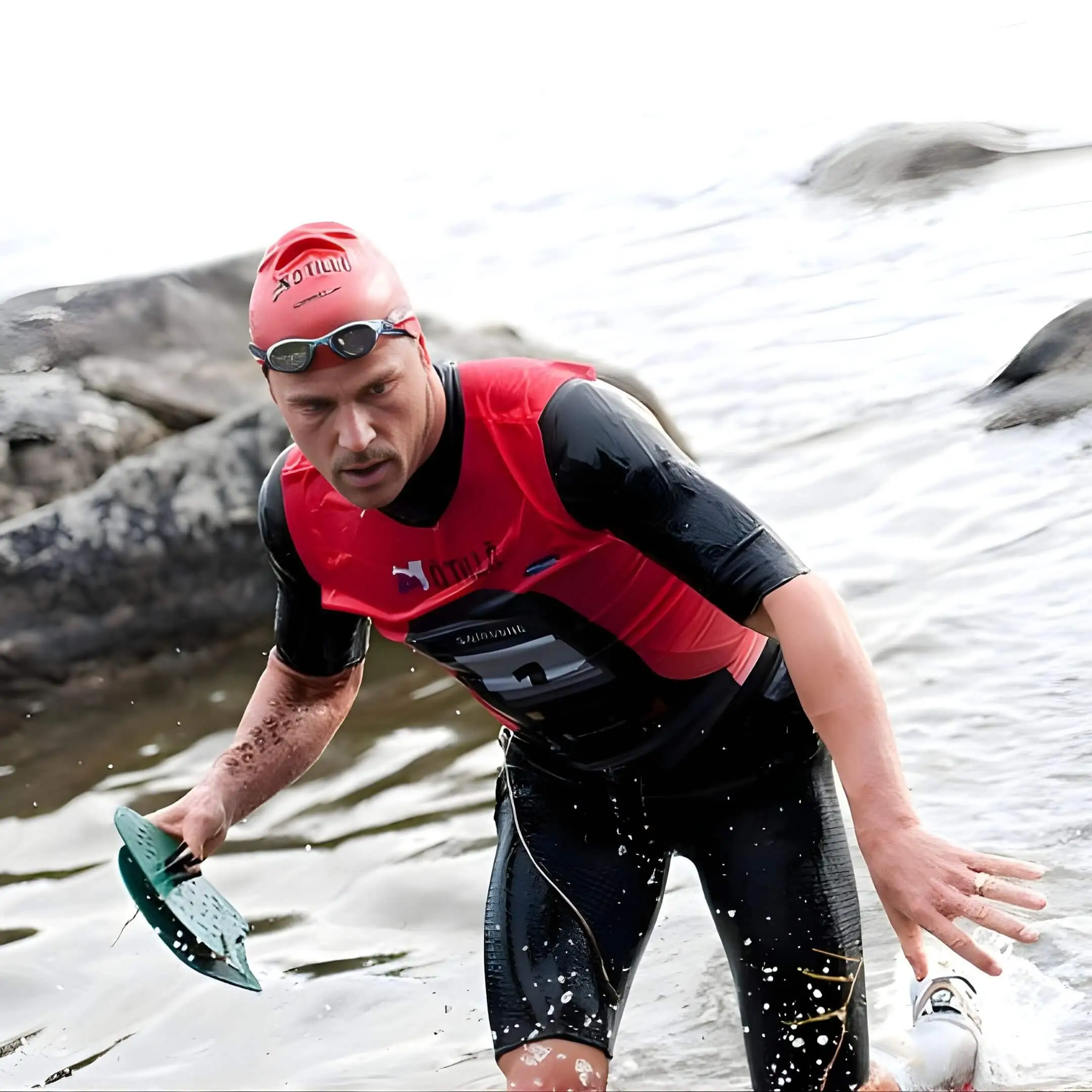
Gordo Byrn is a former investment banker turned professional triathlete at a later stage in life without an endurance sports background. He podiumed at Ironman New Zealand and Ironman Canada, and also became Ultraman World Champion. Today, Gordo is a coach and a prolific writer, with a lot of great thoughts and perspectives on how to improve performance in triathlon and endurance sports, and even in life.
HIGHLIGHTS AND KEY TOPICS:
- The importance of high-volume training, mainly at low intensity, in Gordo’s training philosophy.
- Gordo’s comeback to endurance sports in his 50s after a long time out from consistent and focused triathlon or other endurance sports
- Why you should not do an Ironman within your first year of triathlon training
- The difference between adaptive and maladaptive training load, and how to make sure you stay on the adaptive side.
- The importance of lactate testing to establish your low-intensity training zones
- Practical tips for age-group athletes on how to apply more “elite” or professional training principles to their day to day life and constraints
- The main differences between professional Ironman training methods in the 2000s and today.
Sponsored by:

Precision Fuel & Hydration
Precision Fuel & Hydration produce our favourite gels, sports drinks, and electrolyte and carbohydrate products here at That Triathlon Show and Scientific Triathlon. Use the free Fuel & Hydration Planner to get a personalised plan for your carbohydrate, sodium and fluid intake in your next event, and get 15% off your first 2026 order by using the code TTS2026 at checkout.
Shownotes
Gordo’s introduction
00:45 -
- I am 57 years old now, and I did not come from an athletic or endurance background. In my mid-20s, while working in finance, I decided to get myself into shape.
- That decision gradually led me toward triathlon, although I did not begin competing seriously until my early 30s. I enjoyed the sport deeply, and what I initially thought would be a short break from my finance career ultimately turned into a complete career change into endurance sport. Over time, I managed to train myself to an elite level.
- One of my best overall results came in 2004 at Ironman Canada, where I finished second with what was, at the time, approximately the tenth fastest performance ever on that course.
- I was competitive at an international podium level, although not quite at the level of consistently contending for top-five finishes in Kona. My strengths were always better suited to longer events rather than shorter ones. That became particularly clear in 2002, when I won Ultraman Hawaii.
- That race highlighted that my best performances came in stage-race formats, where I could race for eight hours a day over multiple consecutive days. I tolerated that type of load extremely well, both in training and in competition.
- I married another elite triathlete, and together we have three children. I stepped away from competition for about ten years to focus on family life. In 2022, I decided to return to racing, and I am now back training and competing as a fast age-group athlete.
- Ultraman has a very distinctive format, and if the goal is to perform well, it needs to be approached almost as a single continuous race rather than three separate days.
- The first day consists of a 10-kilometer point-to-point swim along the Kona coast, starting at the Ironman Hawaii swim start, followed by approximately 90 miles on the bike. The second day is an extremely long bike ride of around 174 to 175 miles.
- The third and final day is a double marathon run across the lava fields. By that point, fatigue is significant, and the second marathon in particular can be very demanding. Looking back, almost the entire experience was enjoyable, with the exception of perhaps one hour on the second day and a couple of hours on the third day. I loved being on the island and always enjoyed training there.
- After winning Ultraman, I returned the following year and had a severe reaction after swimming into box jellyfish, which resulted in a hospital stay. That incident effectively ended my warm-water racing and training, as doctors advised against risking another reaction.
- In the year I won, I had already been stung once, which caused significant swelling but did not prevent me from continuing. The second reaction was much more serious. Since then, I carry an EpiPen as a precaution, but I have not had further issues.
- In terms of race dynamics, there are specific moments where the temptation to go too fast is greatest. If you are a strong swimmer, it can make sense to swim the first couple of kilometers relatively assertively to establish separation.
- In my first Ultraman, I had already completed multiple 10-kilometer swims in training and understood the fatigue they produced. I swam comfortably rather than aggressively, maintained a steady rhythm, and exited the water early enough to establish a clear gap on the bike. Being out of sight early was psychologically advantageous.
- On the second day, everyone starts together, which makes the racing more tactical. I waited for a long climb before increasing the effort and attacking to establish separation. That required riding quite hard, as others understood what I was doing and were prepared to follow if they could.
- Once I managed to get away, I could settle into my own rhythm. The third day is very different. By then, everyone knows the time gaps, and the only real way to lose the race is by making a mistake. I chose not to respond to early surges and let others start fast, focusing instead on running conservatively.
- One defining aspect of ultra-endurance racing is how dramatically performance can collapse when things go wrong. I have seen situations where large time gaps disappeared very quickly due to a bad patch late in the race.
- Because of that risk, I was deliberately conservative on the run. When you crack in this type of race, you really crack, and I wanted to avoid putting myself in a situation where the bottom could completely fall out.
Gordo’s time away from the sport
11:51 -
- I have to admit that, both as an endurance athlete and as a coach, I am quite skeptical of what people now call the hybrid or strength-endurance athlete. I tend to be critical of that approach, partly because I lived it myself.
- During the ten-year break I took from endurance sport, especially in the final five years of that period, my focus shifted heavily toward strength training and general work capacity.
- Earlier on, this resembled a lower-intensity version of what would now be associated with CrossFit or similar methodologies. I was not training at the same intensity as those athletes, but I was very strong.
- During that time, I skied extensively in winter, often spending close to one hundred days on snow. That training was split between ski mountaineering and traditional resort skiing, where I focused on steep terrain and moguls.
- As a result, I became a very power-oriented, plyometric athlete. I trained specifically for skiing, including early-season and in-season preparation, with a lot of jumping, plyometrics, and neuromuscular work.
- What I did not do, largely due to time constraints, was long-duration endurance training. I did no swimming at all. I attempted to reintroduce running a few times over those years, but I did not tolerate it well and repeatedly picked up small injuries, so I eventually abandoned it.
- I did hike a lot with my son, who loves hiking, and we spent many days in the Colorado mountains climbing peaks together. That was meaningful and enjoyable, but without realizing it at the time, I was becoming increasingly limited in my endurance capacity.
- My fitness was excellent for efforts up to about sixty minutes, acceptable up to ninety minutes, and beyond that I would completely fall apart. At the time, I assumed this was simply part of aging.
- In reality, I had become metabolically unfit. Internally, my ability to convert fuel into work had deteriorated significantly. This was a stark contrast to my earlier years as an Ultraman champion and elite Ironman athlete, when metabolic efficiency had been one of my defining strengths.
- This became very clear during a rim-to-rim-to-rim hike in the Grand Canyon. The route is roughly forty miles each way, with a night spent on the far side.
- The first day felt manageable, but on the second day, once I reached the bottom of the canyon, I was completely exhausted. While my wife was enjoying the experience, I was fully depleted.
- It was no longer fun, despite being in one of the most beautiful places in the world. That moment was a wake-up call. I realized that something was fundamentally wrong, and that I needed to address it.
- That experience occurred around September 2021. Over the following winter, I reflected on my lifestyle and realized I missed the endurance way of life.
- I missed long, easy training, and I reached a point where my children were old enough that I could realistically reintroduce that commitment. I decided to try to rebuild true endurance fitness again. At that stage, I had no idea whether I could tolerate the training, whether I would enjoy it, or whether I would still enjoy racing after such a long absence.
- The return was gradual and came with setbacks. About three months into the process, I contracted COVID and was sick for roughly three weeks. Beyond that, reintroducing running proved difficult, as I had to manage repeated minor injuries and niggles.
- Swimming was another major challenge. After ten years away from the water, I was extremely inefficient. Technically, I understood what I needed to do, but physiologically and mechanically, my body could not execute it efficiently, and I fatigued very quickly.
- In many ways, I had to relearn how to train from scratch, particularly for swimming and running. Cycling was the one discipline I had maintained to some degree, but even there I had to rethink how to train appropriately and how to integrate it with the other disciplines.
- Fortunately, I have a strong technical background, which allowed me to piece together what was happening in my body and adapt my approach accordingly.
- That technical background comes from my time working closely with exercise physiologists and sports scientists. Toward the end of my elite career, just before my long break, I had a physiology lab in my house. I worked with an exercise physiologist, and together we invested in a metabolic cart.
- This was more than twenty years ago, and at the time, much of what we observed in practice did not align with prevailing scientific explanations. There were aspects of endurance performance, nutrition, and pacing that we were successfully implementing but that the science of the time struggled to explain.
- For example, I routinely consumed around 600 calories per hour on the bike, equivalent to roughly 150 grams of carbohydrates per hour. This approach was inherited from athletes before me, and it was something we practiced consistently in training, not just on race day.
- Despite being told that this was impossible, we were doing it successfully, albeit with far less refined nutritional products than are available today. We carried large amounts of nutrition into the run because digestion and clearance were far less efficient than with modern formulations.
- I wanted access to metabolic testing not only to understand my own physiology but also to be able to speak the same language as scientists and critically evaluate their claims.
- As I returned to training years later, I also wanted to update my understanding, because terminology and frameworks had evolved. Concepts such as heavy, severe, and extreme intensity domains were not part of the conversation when I was racing; instead, we worked largely within simpler zone models.
- Today, different countries and coaching systems still use different terminology, but having trained and worked across multiple systems has allowed me to interpret those differences effectively.
- My familiarity with metabolic testing, efficiency analysis, and long-term physiological data has also been valuable because I can compare my current state to data from my elite years. That longitudinal perspective is rare and extremely informative.
- One of the original purposes of metabolic testing in our coaching work was to help athletes understand why they were blowing up in long races. Often, athletes blamed nutrition, but the real issue was that they were riding at intensities that exceeded their metabolic capacity.
- Testing allowed us to demonstrate appropriate pacing and help athletes choose intensities that would allow them to run effectively afterward.
- What we would now describe as energy pacing was central to that work. By estimating substrate utilization and matching effort levels to metabolic capacity, we could guide athletes toward strategies that felt sustainable and produced better race outcomes. That principle remains just as relevant today as it was then.
Muscular endurance and metabolic efficiency
23:27 -
- Long before the term “durability” became common language, we were already very aware of the concept in practice. The idea that consistent mileage and long-term volume build real performance was central to how I trained. I was strongly influenced by a mileage-driven philosophy, rooted in long days, repeated exposure, and steady consistency.
- The belief was simple: miles make champions. Laboratory fitness metrics were useful, but they represented only a snapshot of performance over roughly an hour. They did not tell the full story of how an athlete performs deep into long-duration work.
- One of the approaches we used to address this was deliberately testing under fatigue. I would complete a long ride of three hours and then immediately undergo metabolic testing to see whether my physiological profile looked the same as it did when fresh.
- When I was truly fit, it did. That ability to maintain efficiency after prolonged work was a defining characteristic of high-level endurance performance. There is research that illustrates this clearly in elite athletes, showing how little changes metabolically even after many hours of work.
- We were already exploring that idea practically by using frequent access to metabolic testing, allowing us to induce fatigue first and then measure what changed. In well-trained athletes, the changes were minimal.
- In contrast, with typical mid-pack athletes, there was often a dramatic deterioration after completing substantial work on the bike before testing.
- A related concept that I still find extremely valuable is exposing athletes to transitions under load. Living in Boulder gives access to open water swimming, and one of my favorite sessions with visiting athletes is to have them swim multiple laps of a one-kilometer circuit and then immediately head out on the bike.
- The goal is not the session itself, but the awareness it creates. Athletes can clearly see how their heart rate and physiological response on the bike differs when they start fatigued compared to starting fresh.
- That experience reinforces the idea that endurance performance is not about being fit in isolation in each discipline, but about being fit across all aspects of the event while transitioning between different modes of exercise.
Gordo’s training week
25:44 -
- My training volume was extremely high. While it did not reach the levels now documented in some of the Norwegian case studies—such as accumulating roughly 1,300 hours per year over multiple consecutive years—the overall load was still substantial.
- Seeing athletes sustain close to 4,000 hours of training over a three-year period is remarkable, particularly when considering the nutritional demands required to fuel that volume.
- For me, even now, fueling becomes a limiting factor, not because of energy availability, but simply because of the sheer challenge of eating enough to support that level of work.
- Looking back, there were two major differences between how we trained then and how I would approach training today. The first was our relationship with fatigue.
- We genuinely believed that being sore and tired most of the time was necessary. We assumed that constant fatigue was simply part of the process, and that we would only feel good once or twice a year when we tapered and raced. That mindset was a mistake. We were frequently living with maladaptive stress, even if not continuously.
- Our focus was on generating fatigue rather than on improving performance. In contrast, when I listen to modern coaches and observe today’s best athletes, the emphasis is clearly on progression and adaptation.
- The question is no longer how much fatigue can be accumulated, but what can realistically be improved over a given training block. The goal is consistent forward movement and positive adaptation.
- Our philosophy at the time was essentially to out-train everyone else, freshen up, and then race fast. While we were undeniably doing a large amount of work, we were not extracting the full benefit from it. This was not unique to us; it was widespread across endurance sport.
- Athletes who survived that era often did so because they had exceptional constitutions and robust immune systems. With modern training structures, many of those athletes could likely have performed at an even higher level, because they had the durability to tolerate hard work but lacked the refinement in how that work was applied.
- The second major issue was how we approached low-intensity training, what is commonly referred to today as zone two. We used the same terminology back then, but our target intensity was generally set higher than where I would place it now.
- Today, I would anchor that intensity around the first lactate threshold or slightly below. Doing so allows for more volume, better recovery, and the ability to execute those sessions even when slightly fatigued without accumulating excessive stress.
- Previously, by pushing that intensity higher as fitness improved, the overall energy demands became too great, eventually pulling us down rather than building us up.
- Ironically, we still accumulated a lot of low-intensity work, but often for the wrong reason. Many days we trained easily simply because we were exhausted, not because it was a deliberate choice aimed at maximizing adaptation.
- Training at low intensity when fatigued is very different from training at low intensity when you feel good and are able to extract a positive physiological response from the session.
- If I look at the overall structure of an elite training week today, it is not fundamentally different from what we did years ago. The core framework remains similar.
- The real evolution lies in two areas: the ability of a small number of exceptional athletes to tolerate extraordinarily high volumes for long periods, and the increasing emphasis on avoiding maladaptive stress in order to sustain continuous improvement over time. Those are the lessons I have brought into my own training now.
- When people talk about training like a professional, they often assume that means training harder. I believe it means training smarter. The objective is to maximize the return on the work being done and to fully benefit from each session.
- Living in Boulder, surrounded by high-performing athletes, I observe that approach daily and continue to learn from it.
Training intervals
32:32 -
- From a running perspective, I typically relied on two sessions that I would consider genuinely hard. One was a marathon-pace–oriented session, which I referred to as a core pace workout.
- If the goal was to run four-minute kilometers off the bike, the core pace would usually be closer to 3:55 per kilometer. In practice, this meant inserting blocks at that pace within a long run, always with heart-rate caps to ensure there was still room to absorb the work.
- This sat firmly in what I would classify as zone three, what is often referred to today as threshold training. At the time, this would have been called tempo work.
- A typical structure might be three blocks of eight kilometers at core pace, performed the day after a very long training day of seven or eight hours. That sequencing allowed some recovery while still maintaining specificity for Ironman racing, and it remains a commonly used approach.
- The second form of faster running I favored consisted of repetitions in the range of eight to ten 800-meter intervals. These were done at a strong pace, generally high zone four in a five-zone model.
- I did very little classic VO₂max work, such as short 400-meter repeats at maximal aerobic speed. That type of training was not specific to Ironman performance, and when I did include it, it was usually well away from competition. Done too close to racing, it interfered with the more specific work that actually moved performance forward.
- On the bike, the training was relatively traditional. I spent a lot of time on big-gear, high-torque work designed to prepare the muscles for sustained high workloads.
- Power output would be high, but heart rate remained moderate. Because of my physiology, I tolerated that style of work very well, and it offered a strong return on investment.
- In addition, I did a significant amount of longer zone three work, what would now be described as heavy-domain training. On flat terrain, this meant sustained big-gear efforts. On climbs, it meant sitting at zone three for 45 minutes to an hour within a moderately long ride.
- I particularly enjoyed doing this type of work at altitude. Living in Boulder made it easy to train between six and nine thousand feet, and I found that tempo efforts at altitude were extremely effective from an efficiency standpoint.
- They challenged the system in a way that translated very well to racing at sea level. When I returned to lower elevations, it felt comfortable to lift above Ironman race intensity.
- For races with rolling or sustained climbs, this was especially valuable. Doing tempo work at altitude and then racing at lower elevation made those race efforts feel internally controlled and manageable.
- With running, I applied a similar logic, although I was more selective. While I occasionally ran at altitude, I generally preferred to do marathon-specific running on flatter terrain. For that reason, I kept most of my key running sessions closer to Boulder’s base elevation rather than higher up.
- Looking back, one thing is very clear: there is no way around workload if the goal is to improve. Even with the mistakes we made—chasing fatigue rather than adaptation—the performances we achieved were still very strong, especially considering the limitations of the technology at the time.
- The bikes, shoes, and overall equipment were far inferior to what is available today, yet the times still hold up. That perspective suggests that, in the modern era, it is easy to become overly focused on optimization while underestimating the fundamental importance of doing the work.
- When I reflect on that period, especially in conversations with former training partners, the conclusion is consistent. We got many things right, but we did not fully understand adaptation.
- We assumed that because we were near the top, our approach must be correct. We did not recognize the mistakes we were making. Today, we can study great coaches and athletes and ask why their bodies adapt so well.
- That level of insight simply did not exist for us at the time. I am also certain that we are still making mistakes today, even if we do not yet fully understand where they are.
- The key distinction is this: volume and load must be maintained, but fatigue does not have to be. The work needs to be adaptive. If the training is not producing improvement, then it is simply making the athlete more tired rather than better.
- In the past, the focus was on pushing load to its absolute limit and seeing how much fatigue could be tolerated. There was very little tactical thinking about whether progress was actually occurring over six-week or similar training blocks.
- That is the major shift I have made in my own training now. I still want to maintain load, but I am very careful to avoid chronic fatigue. Chronic fatigue is insidious; it builds slowly and can be difficult to detect. In fact, it can sometimes masquerade as improved fitness.
- Heart rate may become harder to elevate, efficiency metrics may appear to improve, and power-to-heart-rate ratios may look better. In reality, these changes can reflect suppression rather than adaptation.
- The warning signs often appear instead in how one feels, in sleep quality, and in general well-being.
- This applies not only to high-volume athletes. Even those training at low or moderate volumes can fall into the same trap if they are living busy, stressful lives.
- Nonspecific stress matters. It is not just about how many hard training days are in a week, but how many days overall are stressful. To benefit from training, there must be deliberate periods of lower stress and genuine adaptation built into life as a whole, not just into the training plan.
Managing Load and Stress
41:54 -
- The way I monitor adaptation and ensure continued improvement is quite different from how I approached training when I was younger, and it is also different from how most athletes I train with—both elite and amateur—approach it.
- A key principle for me now is that roughly half of my days are deliberately low stress. Low stress does not mean inactivity or sitting on the couch. It means days where I am not activating my sympathetic nervous system. I am not getting fired up, not getting angry, not overly excited, not traveling, and not stacking unnecessary life stress on top of training.
- I still train on those days. In fact, with a stable routine, I can train two to three hours a day, maintain volume, and recover well, because I am actively shedding stress during those periods. That has been a major shift for me.
- I was strongly influenced by Nils van der Poel’s book, particularly a detail that many people overlook. Most readers focus on the extreme threshold work and the long hours at very high power outputs.
- What stood out to me was that during certain base periods, half of his days were completely off. That made me reconsider how I structured my own training.
- Rather than taking full days off, I chose to experiment with easy days instead, allowing me to keep volume high while keeping overall stress low. My definition of high volume has evolved gradually. In 2022, that might have been around 14 hours per week.
- By building patiently year after year, I am now consistently in the 18 to 20 hour range. This progression has taken place over nearly four years, and it has worked extremely well.
- Another concept that shaped my thinking is the idea of viewing training through the lens of stress rather than intensity. Instead of classifying days or workouts as hard or easy purely based on intensity, I think in terms of overall stress load.
- That perspective has proven very effective. I also adopted the idea that fitness is a continuous function. Rather than viewing training as a series of discrete workouts or isolated days, I see it as an uninterrupted, ongoing process where everything is connected.
- The system never stops. Each session influences the next, and the body is constantly responding to the totality of stress and recovery.
- This way of thinking reframes how we evaluate training. Short sessions matter. Small blocks of work matter. Even brief bouts of strength or plyometric work matter.
- They all contribute to the continuous process of adaptation. There is no requirement to exhaust oneself in a single session and then recover completely. Instead, progress can come from applying consistent, manageable stress over time.
- That is why maintaining volume is so important to me. For endurance athletes, the fundamental driver of development is the ability to convert fuel into mechanical work efficiently over long durations. Volume supports that adaptation more than almost anything else.
- For amateur athletes, this is often the hardest part. Volume is usually the limiting factor, not because of motivation, but because of competing demands from work, family, and daily life.
- My advice in those situations is simple: do not negotiate with yourself. If time is limited, establish a fixed weekly structure—a basic week. Keep it consistent. The people around you will learn it, and you will learn it. Over time, the structure itself reduces friction.
- The specific workouts may vary slightly in duration or content, but the framework stays the same.
- If that consistency allows someone to accumulate even one to three additional hours per week over the course of a year, that can translate into an extra 100 hours of low-intensity endurance training.
- That is a meaningful increase in volume, achieved without adding stress from constant rescheduling or decision-making. It also supports better adaptation, because the system becomes predictable and manageable.
- Equally important is discipline on the upper end. When I was working in finance, I learned that even one extra session or one or two additional hours beyond my limit could derail an entire week.
- I did not have the flexibility to compensate with naps or extra recovery, so I had to force myself to stay below the ceiling. That kind of restraint is just as important as intensity control.
- It is not only about keeping hard days under control; it is also about not adding too much overall load and carrying fatigue into the following week.
- I have consistently found that when I feel tired this week, the cause is almost always what happened last week. Fatigue accumulates quietly. It is rarely about what happened yesterday. Understanding that has been critical for managing stress, maintaining adaptation, and continuing to improve over time.
External stressing factors
50:05 -
- One of the most important factors behind elite performance is often misunderstood. Many people assume that what makes elite athletes fast is a combination of extraordinary genetics or a handful of brutal training sessions.
- In reality, a large part of elite performance comes from the absence of competing demands in daily life. The very best athletes live in an extremely simplified way.
- Their days revolve around training, eating, resting, and spending quiet time at home. There is very little else layered on top of that.
- The athletes who manage to stay at the top for a long time tend to have exceptional psychology, because most people eventually want more from life than a routine of eat, sleep, and train. However, if the goal is to be truly fast, performance requires relentless simplification.
- Every additional responsibility or source of stress has a direct cost. I experienced this very clearly when I had three young children at home. My capacity to recover from serious training dropped dramatically. Even as I reduced volume, recovery did not improve.
- That realization is what ultimately pushed me to step away from competitive racing. I reached a point where the only viable option was to train for health and accept that performance racing was no longer compatible with my life at that stage.
- What I initially thought would be a one-year break turned into a ten-year hiatus, extended in part by the broader disruption of COVID. That experience led to an important insight.
- If someone wants to get faster on the same amount of training, the most effective lever is often not the training itself, but the rest of life around it. Simplifying other sources of stress allows the same training load to produce a greater return.
- The COVID period illustrated this clearly for me. Life became very simple. I trained at home, lifted weights consistently, and became stronger than I had been since my twenties, before I was an endurance athlete. High volume worked, and strength training worked as well.
- That experience reinforced a mindset I still apply today. In the past, I would relocate seasonally, change hemispheres, or travel to make outdoor training easier.
- COVID showed that indoor training options can be extremely effective. With a smart trainer, virtual platforms, a treadmill, and a home gym, I was able to accumulate volume efficiently and with far less fatigue.
- Environmental stress matters. Training outdoors in harsh conditions can dramatically increase fatigue without adding useful stimulus. Indoor training removes many of those variables and allows work to be done with greater control.
- Over time, that efficiency adds up. Even gaining one or two extra hours per week through better logistics can make a meaningful difference.
- I now think a lot about convenience as a performance variable. Living close to training facilities, reducing transition time, and eliminating friction all contribute to sustainable volume.
- Small decisions, such as having a home setup or minimizing travel to training venues, compound over years. As long as overall life stress is managed and does not push the system into a non-functional state, these adjustments allow volume to increase naturally.
- When training and life are organized thoughtfully over long periods of time, it becomes possible to do more work, recover better, and improve steadily—not through hero sessions, but through simplicity, consistency, and control.
Practical Tips for Age Group Athletes
54:34 -
- I place a lot of value on combination workouts. For example, jogging to the pool, swimming two kilometers, and then jogging home. Many people dismiss sessions like that because each individual component feels too short to be worthwhile.
- I completely disagree. That kind of training adds volume, and more importantly, it adds useful volume. If it is done easily, it does not generate excessive fatigue. Instead, it supports adaptation. I think of this as frequency training, and it is highly effective for improving movement economy in both running and swimming.
- The key is keeping these sessions easy. When they are low stress, the body adapts without being overloaded, and they integrate well into an overall program. Frequency, in itself, is a powerful stimulus. For running in particular, I strongly encourage inserting short runs of 20 to 30 minutes whenever possible.
- During periods of the year when cycling volume is lower, increasing run frequency is a simple and very effective adjustment. We used to play a game where, over the course of 30 days, the goal was to complete 30 runs of 30 minutes. Double runs were allowed, and days off were fine. Athletes were often surprised by how much their running improved from these short, frequent sessions.
- The same logic applies to strength training. Wherever possible, I like to pair it with swimming. If there is a gym at the pool, lifting for 15 or 20 minutes before or after a swim is an easy win. Many people feel they do not have time for a full hour of strength work, but that is not necessary.
- Two short sessions per week, focused primarily on the legs and supplemented with a few swim-specific exercises or simple upper-body work, can have a meaningful impact.
- For low- and moderate-volume athletes, these small additions increase frequency without adding significant stress, and economy tends to respond very well to that kind of stimulus. In triathletes, both run and swim economy are often relatively low, which means there is considerable room for improvement through these approaches.
- Indoor training also plays an important role. Twenty years ago, I strongly disliked indoor cycling. The longest session I would tolerate on a trainer was about an hour, and that was only because of extreme heat and humidity.
- At the time, I used a basic setup and tried to distract myself by watching race footage. It was effective but far from enjoyable. Today, the available systems are far better, and indoor training has become a practical and even engaging way to accumulate volume efficiently.
- Work commuting can also be a valuable opportunity to add frequency without increasing time demands. Running or cycling to work often takes no longer than driving, and in some cases is faster. Whenever I moved to a new place, I always tried to minimize my commute because I considered it the most unproductive and stressful part of the day.
- Driving requires constant attention, creates mental fatigue, and offers no recovery. For me, it was the ultimate form of nonspecific stress—becoming tired while sitting still. Whenever possible, I tried to eliminate or reduce driving altogether.
- If commuting can be done by foot or by bike, even partially, it becomes another form of low-intensity movement that contributes positively to overall volume and recovery rather than detracting from it.
Performance improvements
1:00:00 -
- That was one area where I eventually realized I had been doing something right, even though it did not feel right at the time. I was becoming extremely fatigued from what I believed to be very low-intensity training.
- To give some context, when I restarted, my maximum heart rate on the bike was around 165 beats per minute. I was riding at roughly 125 beats per minute, about 40 beats below maximum, and yet a 1,200-kilojoule ride was completely exhausting me. I was also constantly hungry. None of it made sense to me.
- This happened after I had taken a break when our first daughter was born. I was still exercising, but I had clearly lost something. At the time, I still had access to a metabolic lab in my house, and the testing made the issue obvious. I was extremely inefficient.
- The data showed that I needed to ride far easier than I thought was reasonable. That experience stayed with me, and years later, when I began rebuilding again, I decided to quantify things properly.
- I bought a modern lactate testing system, which is vastly better than what we had in the past. The fast readout allows you to take multiple samples quickly and get a very clear picture without physiological drift interfering with the results. When I tested myself, the findings were sobering.
- My lactate began to rise at around 105 beats per minute. As soon as my heart rate went above that, lactate increased in a near-linear fashion. I effectively had no true low-intensity zone.
- Any surge pushed me straight into what would be considered zone three from a lactate perspective. My clearance was also very poor. Once lactate went up, it stayed elevated for a long time. My body simply was not using lactate efficiently as fuel.
- That realization was humbling. It made it clear that the way I had been training was completely inappropriate for where my physiology actually was. What I had believed to be endurance training was, in reality, almost entirely tempo and threshold work.
- When combined with heavy strength training, it meant that every day was a stressor. There were no sessions supporting my nervous system, no true low-end endurance work, and nothing allowing me to absorb the training load. It was obvious why I was run down.
- At that point, I accepted that I had to slow down dramatically. That meant a lot of very easy running, often at six-minute-per-kilometer pace on the treadmill, and very easy cycling indoors to avoid any spikes in effort.
- I tried group swim sessions a few times, but the intensity was far too high, so I swam mostly on my own in order to stay controlled. The focus was entirely on developing the low end. For months, it looked like nothing was happening. Without lactate testing, it would have been easy to conclude that the approach was not working.
- Internally, however, changes were occurring. Lactate values gradually came down, even though heart rate, power, and pace relationships stayed almost identical. Externally, there were no obvious performance markers improving.
- I was not doing time trials, critical power tests, or short benchmark races. I was deliberately avoiding those measures. The only thing guiding the process was the understanding that this low-end capacity was fundamental.
- I knew from experience that general aerobic capacity underpins everything else. I could see what high-level amateur athletes my age were doing, and I also knew I could not tolerate their training volumes because my base was not strong enough.
- The only way forward was to rebuild that foundation patiently. Over time, that allowed me to gradually increase volume, then tolerate more work, and eventually reach—and later exceed—the level I had been aiming for.
- I used a close friend as a benchmark throughout that process. He is slightly older than I am and had followed a similar path: a long break from racing followed by a successful return. He consistently performs at a very high level in his age group, often finishing on the podium or winning outright.
- We raced together when we were younger, and now, in certain years when our age groups overlap, we still compete at the same events. That shared history and ongoing comparison have been both motivating and grounding. It has also been a reminder that long-term development, patience, and appropriate training matter far more than forcing intensity before the body is ready.
Gordo’s feelings about the new training approach
1:06:18 -
- At that stage, my overall capacity was still what I would historically consider high. I had been someone who could tolerate back-to-back 100-hour training months.
- Yet here I was doing large amounts of very easy training, running only about five kilometers three times per week. Biomechanically, my system was so weak that any attempt to run longer or faster immediately resulted in small injuries. Internally, I was skeptical.
- These short, easy sessions felt insignificant, and I doubted that this approach could possibly work.
- But because I was so detrained, it did work. I could see it clearly through lactate testing. As lactate values began to drop, it became very encouraging and reinforced that the process was moving in the right direction.
- As I started adding swimming back into the week, that alone was enough to make me tired. Small components of training were creating fatigue, even though my total volume was only around 14 hours per week. That forced me to accept where I actually was, rather than where I thought I should be.
- By the spring of 2023, I attempted to increase volume and immediately paid the price. Pushing from 14 to 16 hours led to excessive fatigue, requiring a full two-week unload just to recover. When I tried again, the same thing happened.
- It became obvious that I simply did not yet have the capacity to absorb more work. At that point, I committed to listening carefully to my body, not pushing through fatigue, and accepting whatever pace of progression it allowed. I stayed at that level and rolled things forward patiently.
- After a full year, my capacity began to improve, but not dramatically. The changes were extremely subtle. Living with yourself day to day, the ability to tolerate an extra hour per week is almost imperceptible.
- By my second summer back, conditions improved and I introduced two specific types of days. One was what I call a “do-everything” day, where I would swim, bike, run, and lift weights, spreading the work across the entire day with relaxed transitions and no structured main sets. The focus was simply on moving the body.
- The second was a long-ride day. At that time, anything over three hours counted as a long ride for me. I built these gradually, while still relying on long hikes to accumulate time on my legs because I could not yet tolerate long runs.
- Hiking allowed me to load the system without breaking down, even though I knew it was not a perfect substitute for running. Ultimately, the goal was always to return to long running, but that process had to unfold slowly.
- Lactate testing continued to guide the process. As fitness improved, the lactate curve shifted to the right. Lactate levels dropped for a given power output, and the point at which lactate began to rise occurred at progressively higher heart rates, power, and pace.
- That shift became noticeable around 16 months into the process. That was a major milestone. It confirmed that internal efficiency was improving and, importantly, it coincided with my ability to tolerate more volume.
- From a strategic standpoint, I was very deliberate about not trying to fix everything at once. If I think about preparing for an Ironman over a three-year horizon, the first priority is establishing strength and eliminating major limiters.
- I started with a solid strength base, then focused first on resolving the metabolic inefficiency at the low end. The next focus was rebuilding the swim. After that came the bike, primarily through volume, because cycling is the most tolerable way to accumulate large training loads. The run came last.
- Throughout this process, I trained all three disciplines continuously. It was a balanced triathlon program, but the emphasis shifted over time. The bike was the main driver of volume.
- Running remained consistent but deliberately limited, typically around 30 to 40 kilometers per week. Any time I exceeded 40 kilometers, I began to pick up niggles and had to back off.
- This resulted in what I would describe as very high overall training volume paired with relatively low run mileage. Over three consistent years, this approach is enough to complete an Ironman competently. The marathon may not be run to full potential due to limited run specificity, but the overall result will be solid.
- To truly maximize Ironman run performance, however, requires another multi-year cycle. That is the phase I am currently in. In total, it may take five years to approach full off-the-bike running potential again.
- It is an exceptionally gradual process, and that patience is something many people find very difficult—especially those tempted by quick Ironman preparation timelines.
Advice Against Quick Ironman Preparations
1:12:55 -
- My advice is simple: do not rush into it. I discourage people from attempting an Ironman on a short timeline for several reasons. In most cases, it becomes a one-and-done experience.
- The preparation is so demanding and exhausting that even if someone reaches the start line without getting injured, they are often so mentally and physically fed up that they leave the sport altogether.
- That outcome defeats what I believe amateur sport should be about. For me, amateur endurance sport is fundamentally about lifestyle. It is about health, long-term well-being, the places you get to visit, and the people you meet along the way. That is where the real value lies.
- If the goal is to do this in a way that is positive and genuinely transformative, the correct time horizon is not months but years. I think in terms of a thousand days, roughly three years.
- That allows the process to unfold in a sustainable way, where training enhances life rather than consuming it. The same principle applies to running.
- I often tell people not to sign up for a marathon quickly. Rushing into marathon preparation is one of the most reliable ways to get injured. Even if someone makes it through the race, they are usually so depleted afterward that they need extended time off, which effectively resets their fitness and motivation. The cycle becomes disruptive rather than constructive.
- For triathletes in particular, I usually advise against racing a standalone marathon unless there is a very strong personal reason to do so. If the goal is to improve running, marathon-style training can be useful, but racing a half marathon is far less disruptive.
- Recovery is faster, the physiological cost is lower, and the training fits much more smoothly into an ongoing endurance lifestyle. The marathon itself is an exceptionally demanding event, and unless someone truly wants that experience, it is often not the best choice.
- The same logic applies to Ironman racing. For most people, even a 70.3 is a significant challenge if approached on a short timeline. While it is possible to get through one by pacing conservatively, it is still an ultra-endurance event for the vast majority of athletes.
- If someone is looking for a stretch goal, that can be appropriate, but if the underlying ambition is to become genuinely competent in the sport, then a long apprenticeship is the right path.
- To perform decently over time, certain foundations must be built: health, strength, metabolic capacity, general endurance capacity, and eventually specific race capacity. When those foundations are in place, specificity can be layered in relatively quickly.
- With strong general capacity, it may take only a short preparation period to become race-ready for many events. That does not mean six weeks is enough for a marathon or an Ironman, but it does mean the preparation does not need to be overwhelming if the base is already there.
Three-year Ironman program
1:17:08 -
- When I started again in April 2022, my expectations were very simple. I wanted to feel better mentally and physically. That was the primary motivation, and it was very similar to why I first began endurance sport in my mid-20s. I wanted to feel better in myself.
- That improvement came quickly. Despite setbacks such as COVID and a series of minor injuries, within three or four months I could clearly feel that returning to endurance training was having a positive effect on both my head and my body. At that point, I knew this was going to be a good thing for me.
- About a year later, I traveled to Sweden to visit a close friend and race ÖTILLÖ, a swimrun event in the archipelago. I had won that race once before many years earlier, and that remained one of the last major races I had won in my earlier career.
- He had competed in the race every year since its inception, and he agreed to take me on his team again. That commitment became a strong motivator for me to swim consistently, because swimrun racing demands a lot of time in the water. The experience was enjoyable. We were slow, but I had a lot of fun, and I rediscovered how much I enjoy long days of training and racing.
- From a performance standpoint, however, it was the worst ultra-distance race I have ever done. When we had won the race years earlier, we finished in around nine hours. This time, we were out there for more than twelve. For the first nine hours, things went surprisingly well.
- Given my limited run training, I knew I did not need to run fast; I just needed to stay with my partner. In the end, we both cracked at roughly the same time, which oddly worked in my favor. Once we slowed down together, the final three hours were very slow, but we still enjoyed the experience and finished the race.
- That race led to a clear decision. If I was going to do another ultra-endurance event, I did not want to fall apart again. I wanted to be properly prepared.
- The following year, my focus shifted toward cycling, with the long-distance Alpe d’Huez triathlon as the main objective. I had heard about the race for years but had never competed in it.
- I was told that the bike leg feels similar in duration to an Ironman bike, not because of distance, but because of the elevation gain, including multiple long climbs and the final ascent of Alpe d’Huez itself. That made it an ideal stepping stone if I was considering a return to Ironman racing.
- The total race took me just under seven hours. It was long enough to be meaningful without being overwhelming. The run was relatively short in duration, roughly an hour and a half, but with significant climbing, which made it demanding in a different way.
- The race served its purpose perfectly. It allowed me to assess how I handled long bike efforts in a race context, and it confirmed that the progression I was following made sense.
- Across those two years, I used races strategically to shape my behavior. ÖTILLÖ motivated me to swim consistently. The Alpe d’Huez triathlon motivated me to ride a lot. In both cases, the events guided my training focus rather than forcing everything at once.
- They also provided valuable benchmarking. Racing against strong athletes in my age group gave me an honest sense of where I stood. I enjoy mixing events where I expect to perform well with others where the outcome is uncertain and the competition is strong. That balance keeps the process engaging and informative.
Roth preparation and review
1:22:10 -
- At that point, I knew I was in very good shape. I had raced the Boulder 70.3 and was the fastest athlete in the 40-plus category, despite being 56 years old and competing against athletes up to sixteen years younger.
- Given the strength of the triathlon community in Colorado, that race served as a very solid benchmark. It ended up being my best race of the year.
- It was placed in the middle of an Ironman training block during a 20-hour week, and I treated it as a low-priority race, with just a couple of easier days beforehand. That result confirmed that my general preparation was working.
- Conditions that day included unusually warm water, meaning no wetsuits for amateurs. While that initially disappointed me, I quickly realized it likely worked in my favor.
- As a high-volume athlete, I tend to benefit when races are more demanding. The swim went well, largely because I was able to draft a single athlete who effectively pulled me around the course after the first 1,500 meters.
- On the bike, I felt exceptionally strong. However, the dynamics of modern racing are very different from when I competed as an elite. Draft zones are now much larger, and bikes are far more efficient.
- In practical terms, that means it is extremely difficult to ride away from groups unless you can sustain very high power outputs for extended periods. On a multi-lap course like Boulder’s, there is typically only one real opportunity per lap to break away, usually on a climb.
- Early in the ride, riders were passing me aggressively, and it took some time to understand how the race would unfold. Eventually, the field began to form large clusters, and even while riding legally, the aerodynamic benefit of being near a large group was substantial.
- Speeds were consistently in the low 40 km/h range, and the race became quite tactical.
- The bike leg went very well overall. Toward the end, I was riding strongly, but I made a mistake late in the race. On the second lap, I became frustrated with the group dynamics and attacked hard on the climb, riding alone into the wind for the final 60 kilometers.
- I spent a huge number of kilojoules to gain very little time—around 90 seconds—because the large group eventually came back together behind me. That effort came at a significant cost.
- On the run, I made two key errors. First, I underestimated how much fueling I now require while running. My running economy is lower than it was when I was racing elite, and the nutrition strategy that used to work for me was no longer sufficient. Second, the overextension on the bike compounded the problem.
- My marathon strategy has always been to start at a conservative effort, around the top of zone one, with the intention of gradually increasing effort through the second half while holding pace steady. That day, I was unable to execute that plan. Pace gradually declined as fatigue accumulated.
- In Ironman racing, the timing of difficulty matters enormously. If the race becomes hard with only ten kilometers to go, it is manageable. If it becomes hard with twenty-five kilometers remaining, the psychological load is much greater.
- In my case, the slowdown began too far from the finish. I was also aware that I was far ahead in my age group and that no one my age had ever gone that fast on that course. That knowledge influenced my decision to settle rather than fight aggressively through the final stages.
- Despite those issues, the result was still very strong. I finished in just over nine hours and won the age group. At the same time, the race left me hungry to do it better. I decided not to return immediately, choosing instead to wait another year before attempting Ironman again.
- Leading into Roth, my training remained firmly grounded in the fundamentals we have been discussing, but with significantly increased volume.
- Throughout the summer, I averaged around 20 hours per week consistently. I also raced strategically, using a 70.3, an Olympic-distance triathlon, and a standalone 5 km race as my primary high-intensity sessions.
- I did not have the capacity to perform the long, marathon-pace run sessions I had used earlier in my career, such as repeated long blocks at core pace. Instead, I relied on alternative approaches.
- One key session was a broken marathon on the treadmill, totaling slightly more than marathon distance across two runs. This was done about two weeks before the race to prepare the legs without risking injury. I also used combination days.
- For example, on the day of the Olympic-distance race, I ran an additional 10 km later in the day, and the evening before, I ran another 10 km. That allowed me to accumulate 30 km of running within a short window without the stress of sustained high weekly mileage. This approach suited me because I did not tolerate chronic run volume well.
- Bike training was more traditional. I focused on long rides that included sustained blocks at or above Ironman effort. My minimum target for those intervals was an average of around 230 watts.
- Many of these sessions were done at altitude, using long climbs and extended out-and-back sections to accumulate three to three and a half hours of work at race intensity within rides totaling around 5,000 kilojoules.
- I often followed these rides with a 10 km run to assess decoupling. Maintaining stable heart rate-to-pace relationships off the bike was a key marker for me.
- These sessions mirrored the philosophy behind some well-known long-course training approaches, emphasizing sustained race-specific effort and controlled execution rather than maximal intensity.
- On the run, I imposed strict heart rate caps. While I still had the capacity to run much faster, especially in shorter races, I deliberately limited effort in training to remain in zone three. The objective was efficiency and durability, not speed for its own sake.
Key takeaways
1:36:40 -
- If I had to distill the key lessons, the first one is very clear: build the volume first. In our sport, performance exists on a continuum, with levels all the way up. If I have aspirations to race at a certain level, I need to understand what that level actually requires.
- One thing I did well when I came back was observing what successful athletes around me were actually doing. Many strong athletes share their training openly, and it becomes very easy to see the reality of the workload.
- From that, it became obvious that if I wanted to be competitive again, I needed a body that could tolerate around 18 hours per week during race preparation. That gave me a concrete target, not based on theory, but on reality.
- The next point is individualization. I paid close attention to what actually works for me. I have a long history in the sport, and certain methods have consistently worked well for my physiology.
- I focused on keeping those elements and ignoring distractions. In triathlon, there are always trends, supplements, and novel training ideas competing for attention.
- None of that matters if the fundamentals are not in place. What matters is dialing in the basics and having a stable, repeatable weekly structure. That basic week is far more important than any marginal gain.
- Another critical piece is understanding physiology properly. If the goal is to improve, knowing where the first lactate threshold sits is essential. Even with decades of experience, I was unable to feel accurately when my lactate was rising, and I ended up training inappropriately for my actual fitness level.
- Once that information is available, the next step is having the humility to train according to it, even when it feels too easy or counterintuitive.
- One of my biggest mistakes was not asking for help early enough. I eventually brought in a coach, which made a meaningful difference. I was fortunate to work with someone extremely knowledgeable, and that outside perspective helped guide my comeback more effectively.
- What I did not do early enough, however, was seek expert physical therapy support. I waited until I was injured, and that decision likely set my running back by well over a year. Had I addressed underlying issues sooner, I would have been able to train properly much earlier.
- Once I finally sought help, the change was significant. I was able to resolve limitations that were preventing me from running as my cardiovascular system and muscular system were capable of.
- Until then, my nervous system had been the limiter, and I could not solve that on my own. There are people in our communities with deep, case-based knowledge who have spent decades solving these exact problems. It is unrealistic to think we can replicate that expertise ourselves.
- The lesson is simple but important. If there is a persistent issue—whether in swimming, cycling, running, bike fit, or chronic pain—there is almost certainly someone who can help.
- The challenge is finding that person and then being willing to follow their guidance. Doing so can unlock progress that might otherwise remain inaccessible for years. That shift was pivotal for me, and only now, several years later, am I fully starting to see the benefits, particularly in my running.
Resources for Athletes
1:43:01 -
- I currently produce a large amount of content, which is why I have structured it across several platforms. I run three Substack publications and a YouTube channel.
- The primary publication is Endurance Essentials. That platform is entirely reader-focused. I use it to publish preview chapters from my books and to write articles aimed directly at athletes, helping them think more clearly about training, performance, and long-term development.
- I also publish True Wealth, which reflects my background in finance and a broader interest in family, relationships, and long-term life planning. That content is intentionally very different from my endurance writing.
- It is not about efficiency, workouts, or performance metrics, but about managing life well: parenting, marriage, financial security, and the decisions that shape stability and fulfillment over time. While it may not appeal to the same audience, I believe it is deeply valuable in a wider life context.
- The third publication is simply my personal blog. I wanted a place where I could write more freely about what I am thinking about and experiencing, without diluting the focus of the other two publications.
- Because sport remains central to my life, much of that content still relates to endurance, but it is written from a more personal perspective.
- Keeping these streams separate allows readers to choose exactly what they want to engage with, rather than being overwhelmed by volume or mixed themes.
- In addition to that ongoing work, I recently co-authored a book titled From Lemon to Legend. I was the lead writer, working alongside two collaborators whose expertise I deeply respect.
- The book is designed as a comprehensive reference for swim, bike, run, and triathlon across all distances. The intention was not to create a race-specific manual, but to produce a resource that an athlete could spend an entire career working through.
- It reflects my training philosophy of building fitness gradually, in layers, with an emphasis on long-term development rather than short-term fixes.
- The book includes structured workouts, linked resources, and detailed discussions of concepts such as combination training and progression across disciplines.
- Nutrition is addressed in a way that differs from many conventional approaches. While I believe in being precise when it matters—such as race planning and key training sessions—I do not believe that long-term performance is driven by obsessively counting calories or macros.
- The reality is that we cannot be accurate enough over weeks and months for that approach to be reliable. Instead, I emphasize awareness, consistency, and understanding behavior.
- In my view, the biggest nutritional errors are rarely caused by a lack of knowledge. They are usually driven by emotional factors and mistaken beliefs that influence eating behavior over time.
- Under-fueling and over-fueling are often symptoms of deeper issues rather than informational gaps. That perspective is explored in depth in the book, because it directly affects health, recovery, and performance sustainability.
- What I ultimately wanted to create was a book that presents a coherent philosophy of training, supported by practical tools and technical insight. It brings together my experience with endurance performance and the complementary expertise of my co-authors, who have extensive backgrounds in sports medicine, Olympic-level coaching, and elite short-course racing.
- Their perspectives strengthened the work significantly, challenged my assumptions where needed, and ensured that the material remained grounded, balanced, and applicable across a wide range of athletes.
Different perspectives on the book
1:49:30 -
- There were definitely areas in the book where differing perspectives came through, and I was comfortable allowing that. One example is arm carriage in running.
- I prefer a higher arm position. I find it relaxes the shoulders, shortens the pendulum, and feels efficient. That approach was taught to me when I was an elite athlete, and I still see it reflected in athletes I admire.
- Others favor a more open arm carriage with less vertical movement, which is also common among elite marathoners. We did not fully agree on this, and rather than forcing a single conclusion, we presented both approaches and encouraged readers to experiment and decide what works best for them.
- Another area where we differed was run–walk strategy. Based on years of coaching amateur athletes to significant Ironman personal bests, I strongly believe in planned run–walk methods.
- If walking is going to happen in a race, I believe it should be trained, planned, and normalized. Walking a few steps does not mean the race is over. I have used run–walk successfully myself at a high level, and I have seen it produce dramatic improvements in amateur marathon times.
- That said, not everyone agrees with this philosophy, and again, rather than excluding it, we included both viewpoints and left it to the reader to test and decide.
- Where my thinking genuinely changed was around maladaptive stress. Long before that term was widely used, it was pointed out to me that I was often chronically overreached.
- I was training at a level of fatigue that most athletes would not tolerate, and while my constitution allowed me to survive it, it was not optimal. Looking back, I regret not leaning more into that perspective earlier.
- Had I been willing to accept stricter constraints around fatigue and focus, I may have unlocked a higher level of performance. I can see now that I was too comfortable being constantly tired and relied too heavily on extreme volume and very long sessions.
- That insight fundamentally reshaped how I train today. I now place far more emphasis on managing stress and ensuring that the work I do is adaptive rather than simply accumulative.
- I still value volume and consistency, but not at the cost of chronic fatigue. That shift in mindset has been one of the most important evolutions in my approach, and it is something I wish I had embraced earlier in my career.
Trends that Gordo does not agree with
1:53:04 -
- This reflects a broader life philosophy that I apply well beyond sport. When I encounter someone I respect who is clearly successful but approaches a problem very differently from me, and we cannot reach agreement, I assume that the point of disagreement is probably not decisive. In other words, it is unlikely to be the factor that determines success or failure.
- Nutrition is the clearest example of this. Highly successful athletes eat in very different ways, using markedly different nutritional strategies. That tells me that the exact macro distribution is probably not decisive.
- Because it is not decisive, I do not need to be “right” about it. I can afford to be flexible and less dogmatic, focusing instead on broader principles that support consistency and long-term performance.
- What I find more interesting is the inverse of that question. When successful people who think very differently nonetheless agree on certain fundamentals, those areas deserve attention.
- That is where I focus my energy. Volume is a good example of this. Across methodologies, philosophies, and eras, volume consistently appears as a shared point of agreement among successful endurance athletes. That is one reason I place so much emphasis on it.
- When it comes to intensity, my view is that most athletes are doing too much. Excessive intensity is closely tied to stress and to nervous system load. I believe this is an area where athletes can gain a real advantage by doing less, not more, and by paying closer attention to nervous system health.
- The challenge is that nervous system function is extremely difficult to measure. Unlike power output, which gives immediate and precise feedback, nervous system metrics are indirect and noisy.
- I track tools such as resting heart rate and HRV, not because they are perfect, but because they provide long-term trends. Over several years, I have seen my average HRV increase meaningfully, but those changes occur very slowly and are almost impossible to detect day to day.
- Subjective indicators are often just as important: how easily I fall asleep, how well I stay asleep, how patient I am in daily life. These are all reflections of nervous system state, even if they cannot be easily quantified.
- From the outside, it is often obvious when an athlete is underperforming because their nervous system is overstimulated. They appear frazzled, impatient, and unable to absorb training.
- Yet it would be very difficult to prove this in a clinical setting or provide a clear diagnostic label. This is why some coaches dismiss tools like HRV entirely, while others find them useful. The disagreement is not really about the tools themselves. It is about measurement.
- If we step back from the tools and ask whether nervous system function matters, I think there is broad agreement that it does. The lack of consensus lies in how to observe it, not in its importance.
- For me, that distinction is critical. Even when measurement is imperfect, the underlying principle remains worth respecting and managing carefully.
LINKS AND RESOURCES
- Gordo’s Substacks: Endurance Essentials, Gordo’s Substack, True Wealth
- Gordo’s Youtube, Twitter and Instagram
- Gordo’s book (with John Hellemans and Julie Dibens): From Lemon To Legend: A Comprehensive Guide To Running, Cycling, Swimming And Triathlon
- Papers cited
- Aerobic Energy Turnover and Exercise Economy Profile During Race Simulation in a World-Record-Breaking Male Full-Distance Triathlete - Christensen 2024 (the Magnus Ditlev case study, already a modern classic in triathlon science)
- How to Skate a 10k by Nils van der Poel (free download)
